If you’ve ever set a Google Alert for “chronic absenteeism,” you’ve seen how constant the conversation is. One day it’s a state sounding the alarm, the next it’s a district piloting a new approach, and every so often there’s a result that makes you pause and think: okay, this is worth studying.
A recent example: a West Alabama middle school reported cutting absenteeism in half by using monthly games and a house-style points system tied to attendance, academics, and participation. The takeaway isn’t that incentives magically solve everything—it’s that structure, belonging, and visibility can move the needle when they’re done consistently.
That context matters, because when we arrived at FETC 2026 in Orlando, and was greeting attendees at our Minga Engagement Wall, student attendance was still top of mind. At different conferences, in different conversations, the same underlying pressure: school leaders are still working to rebuild routines, motivation, and trust—day after day.

The Minga Engagement Wall Explained
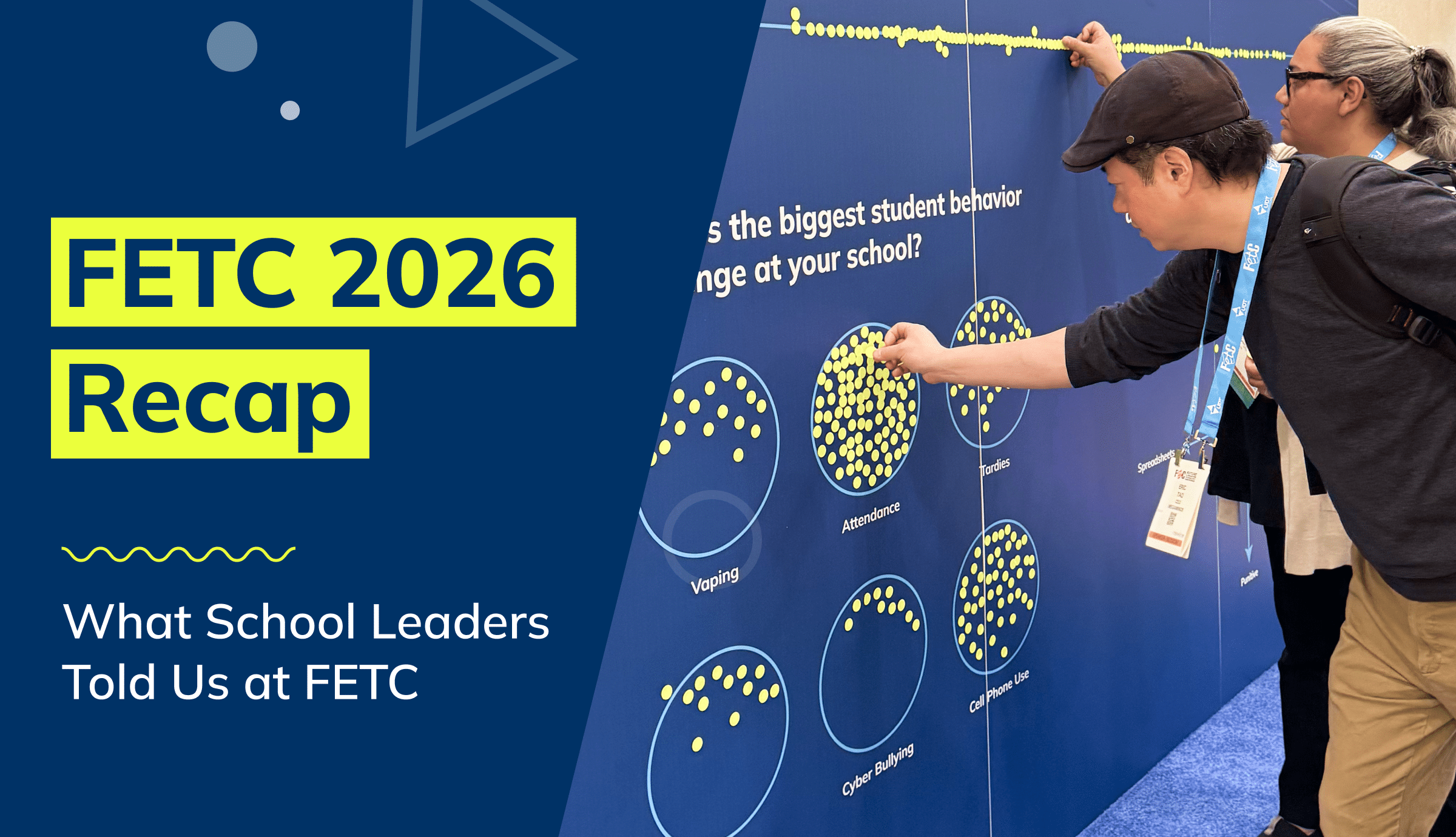
At UNITED 2025, we created a simple, analog Engagement Wall—a place where school leaders could share what they’re seeing without the polish that often comes with panels and presentations. We brought it back at FETC 2026 to see what’s shifted and what hasn’t.
This year, attendees weighed in on three questions:
- How well does your existing school technology foster student connection and engagement?
- What is the biggest student behavior challenge at your school?
- How do you currently manage behaviors at your school?
The goal was straightforward: surface patterns, compare notes, and capture what’s rising to the top across schools.
What School Leaders Told Us at FETC 2026
1) Attendance and Tardies Still Lead the List
The strongest concentration of responses landed on Attendance/Tardies again. What stood out wasn’t only the number of stickers—it was what that cluster represents: this challenge is no longer occasional. It’s operational, persistent, and shaping how leaders spend time and attention.
2) Cell Phones Remain a Major Friction Point; Vaping Showed Up Less
Cell phones remain front and center in discussions about school behavior, especially as campuses adjust to shifting expectations and changes in cell phone policies. Educators shared how students are getting creative—sneaking phones into class, handing over “burner” phones instead of their real device, and pushing schools into tough, time-consuming conversations when enforcement escalates.
3) Bullying and Violence Ranked Lower Than Before
Bullying and violence were present on the wall, but they did not dominate. Compared to UNITED, they appeared less central in the immediate “top behavior challenges” set—an encouraging signal, even if the work continues.
The most notable shift wasn’t the headline challenge. It was the evolving “how.”
Google Docs and Slides as Modern Note Passing
One principal described how behavior patterns can shift after tighter phone rules: fewer issues tied to phones, but a rise in students using collaboration tools for off-task messaging. The challenge is keeping the upside of collaboration while adding the guardrails that protect students and learning.
“The cell phone ban has been a positive step, but students have shifted to messaging through Google Docs and Slides. We want collaboration, while keeping tool use appropriate and purposeful.”
Dr. Tim Sparbanie, Principal, Elaine Thompson Elementary
Scholastic Esports as a Belonging Lever
A teacher shared that scholastic esports can improve attendance and punctuality when it’s treated like a real program with clear commitments and team accountability. For some students, being on a team turns “showing up” into something other people are counting on.
“They will actually come to school early to be on time… because I don’t want to let my teammates down.”
Etheard Joseph, Teacher, Jupiter High School
Why Attendance and Tardies Are Still an Engagement Issue
Arturo Ruelas framed it in a way many educators recognize immediately: relationships drive engagement, and engagement drives attendance. When students feel seen and supported, they’re more likely to arrive on time, follow routines, and participate in learning. And underneath that, there’s a broader mindset shift that keeps surfacing: some students genuinely treat school as optional after years of disrupted routines and flexible learning models.
Why Are We Still Dealing With Attendance Issues? Maybe School Doesn’t Feel Important to Kids Anymore.
At FETC 2026, the attendance conversations had a familiar undercurrent: a growing number of students aren’t treating school as a default. They’re weighing it—consciously or not—against what feels relevant, manageable, and worth it that day.
These six themes came up again and again in different ways on the floor, here’s how they sounded through an “in-the-room” lens:
- “We proved we can do this from home.”
Remote learning normalized the idea that schoolwork can happen without physically being in the building. For some students, that shifted attendance from a requirement to a choice—especially on hard mornings. - “If it doesn’t feel relevant, it’s hard to show up.”
When learning feels disconnected from students’ lives, motivation drops first and attendance follows. We heard versions of this framed as: students show up when they believe the day will matter to them. - “Some homes are stretched thin—and school feels like one more thing.”
Families carrying stress around work schedules, transportation, childcare, or basic needs can struggle to keep consistent routines. When that support is uneven, absences pile up quickly and can turn into a pattern. - “The expectation message isn’t as firm as it used to be.”
Multiple educators described a shift in what students hear at home about attendance—less “you have to go,” more “we’ll see.” When expectations are inconsistent, students treat school as flexible. - “Kids don’t always believe attendance changes the outcome.”
When students think they’ll pass or graduate regardless, it’s easy for attendance to feel optional. That perception—right or wrong—reduces urgency to show up consistently. - “Sometimes it’s not motivation—it’s the setup.”
A lot of absenteeism (and lateness) isn’t about students deciding school doesn’t matter—it’s about real barriers: transportation, caregiving, housing, health, and schedules that don’t fit how teenagers actually function. At FETC, we heard a reminder to get practical: before labeling it a “behavior problem,” look at what the day is asking of families.
“My granddaughter is 17, and the school starts at 7:30… you have to be realistic when you’re 17, you need to sleep in the morning… maybe you need to look at the schedule and make it more flexible. Find out the family issue.”
Barbara Bray, author, coach, podcast host
Where Minga Helps Improve Attendance & Tardiness
FETC 2026 reinforced something school leaders already feel daily: improving student attendance doesn’t happen with posters and pep talks alone. It improves when expectations are clear, follow-through is consistent, families are informed early, students are engaged, and “bathroom meet-ups” don’t compete with class time.
So…easy, right? 😅
That’s the work—and it’s where Minga has been supporting schools post-pandemic. Minga is turning attendance and tardy management from a manual scramble into a system schools can actually run. With self check-in for tardies, automated family notifications, and clean reporting, schools move from “we know this is happening” to “we can see patterns and intervene sooner”—before a few late arrivals become chronic absences.
On the student engagement side, schools are thriving too—especially the ones that assumed points and rewards were “an elementary thing,” not a high school motivation tactic.
At the end of the day, Minga helps you stop managing tools and start running your school—so you get more time back with students. When patterns show up, you can sit down with a student, ask what’s going on, and figure out how to help, instead of spending every morning putting out the next fire. The goal is student success, not survival mode.