For most parents, what happens during the school day is a total mystery. They don’t know whether their child made it to third period on time, whether that missed math assignment was turned in, or why they’re suddenly seeing a notification about a hallway violation three days late. They want to be part of their child’s success, but without consistent teacher and parent communication, often their only window into the school day is a crumpled permission slip at the bottom of a backpack or a surprise phone call from the office.
When school communication with parents is clunky, it allows bad (and good) behavior to go unnoticed. Teachers feel the weight of manual outreach, and parents feel disconnected from the daily reality of the classroom. To encourage positive student behavior, we have to move past old-school ways of reaching out to parents and build more consistent and reliable school-home relationships.
Why Teacher and Parent Communication Matters for Student Behavior
The importance of teacher and parent communication isn’t just about sending updates; it’s about building a partnership. When families feel informed, students feel supported, and their behavior reflects this. Real-world outcomes show that consistent communication leads to better student engagement, improved behavior, and a more positive school climate.
- A Harvard University study titled “The Underutilized Potential of Teacher-to-Parent Communication” found that weekly, one-sentence individualized messages from teachers to parents:
- Reduced credit failure by 41%.
- Increased student engagement in the form of higher homework completion and class participation.
The study specifically noted that “improvement-oriented” messages (telling parents what their child could work on) had the most significant impact on behavior.
- The National PTA highlights that when families and school staff engage in regular, two-way, meaningful communication:
- Students earn higher grades and test scores.
- Students show improved behavior and better social skills.
- There is a direct correlation between more regular attendance and higher graduation rates.
- Research into school climate from the Virginia Department of Criminal Justice reveals that a positive environment that’s built on structure and support (both of which are reinforced through home-school communication), is associated with:
- Higher levels of student engagement.
- A stronger attachment to the school, which reduces “at-risk” behaviors.
The research all points to the same thing, that teacher and parent communication is essential for student success. But for a busy administrator or a teacher managing thirty students, consistent communication can feel like just another task on an overflowing to-do list. The goal isn’t to give educators more work; it’s to provide an easy way to flag worrisome student behavior before it gets worse.
How Does Teacher and Parent Communication Improve Student Behavior?
Making the “Invisible” Visible
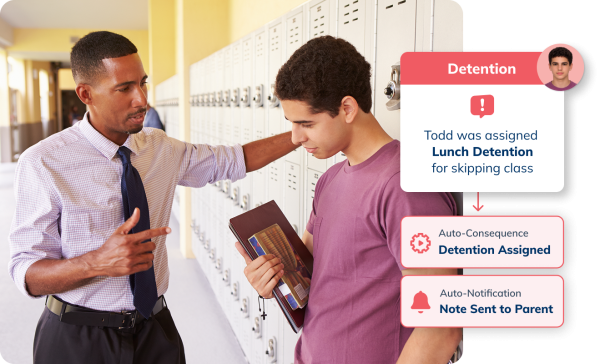
When students know that school and home are on the same page, they make better choices in the hallways, in the classroom, and across the entire campus. In many schools, what happens during the day is a total mystery to parents. And students often feel like they can drift between classes or skip a period because the news won’t reach home for days, if it ever does at all. When a student realizes their parents will know they were out of class before the final bell even rings, they are much more likely to stay on track and do the right thing.
Turning Data into Dialogue
We often treat behavior data as a record for the office, but its real power is as a tool for the dinner table. Effective teacher and parent communication gives families the specific information they need to have meaningful conversations. Instead of a parent asking, “How was school?” and getting a one-word answer, they can say, “I saw you were recognized for helping a peer in the hall today. Tell me about that.” This shift doesn’t just improve behavior; it builds student confidence and reinforces that the school is a place where their positive actions are noticed and valued.
How Can Schools Effectively Communicate With Parents?
Traditionally, schools have relied on a patchwork of methods that often add to the noise rather than reducing it. While paper flyers and mass emails have their place, they lack personalization and don’t provide real-time updates.
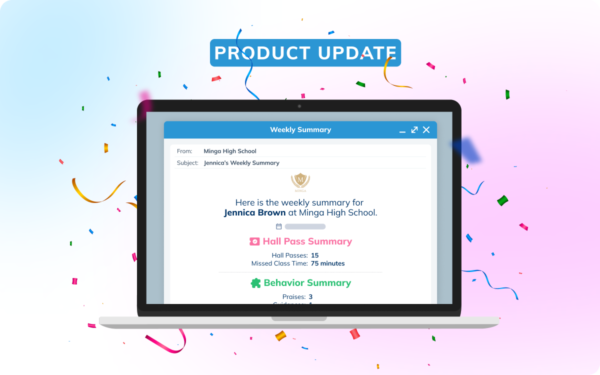
In a modern school environment, these delayed methods fail to influence student behavior because the “teachable moment” has already passed by the time a parent sees the message. When a behavior update takes three days to reach home, the connection between the action and the consequence is lost. To actually improve student behavior, communication needs to be immediate. This is where a unified digital approach changes the game. By using software to automate instant alerts or schedule weekly notification summaries, schools can keep every family in the loop without adding a single task to a teacher’s plate. It turns a manual, exhausting process into a simple way to make sure no student falls through the cracks and no parent is left guessing. To truly support student behavior and outcomes, teacher and parent communication must be as fast as the school day itself.
5 Ways to Improve Your Communication With Parents
Effective school communication with parents relies on three things: timing, tone, and transparency.
- Bridge the gap between school and home: Instead of sending a generic alert that a student was out of class, give parents the context they need to help. For example, instead of “Student is out of class,” a notification like “We noticed [Student] has been out of class frequently this week. Here is a quick summary of their hallway time so you can chat with them tonight” turns a data point into a conversation starter.
- Focus on positive reinforcement: Behavior shifts when students feel seen. Don’t let the only communication home be about negative incidents. Use your parent notification system to celebrate wins, like a student being recognized for upholding school values. When a parent gets a “win” notification right away, it reinforces that positive behavior the second the student walks through the front door at home.
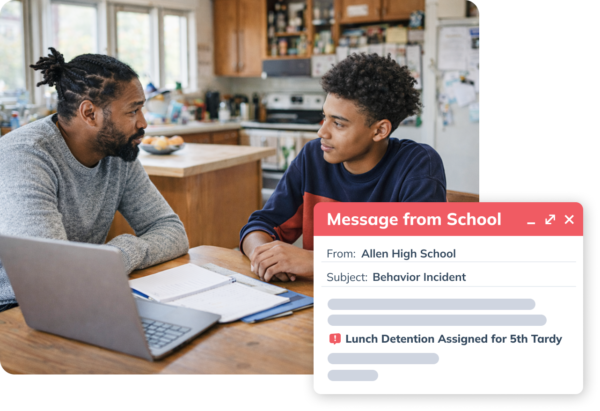
- Automate the “busy work”: This is where teacher and parent communication becomes invisible and effective. Instead of a staff member calling fifty parents about a tardy, an automated system can send a respectful update on the spot. This protects teaching time and keeps parents informed without adding to the office workload.
- Keep a steady pulse: Good teacher and parent communication shouldn’t be a flood of info once a month. It works best when it’s a small, regular part of the week. When updates are short and frequent, parents don’t feel like they’re being “managed”—they feel like they’re part of the team. This predictable rhythm takes the guesswork out of school life and makes sure there are no “surprises” for families at the end of the term.
- Use the “then and there” approach: To actually change student behavior, the parent notification needs to reach home while the day is still fresh. Sending a digital note right away ensures that by the time the student walks through their front door, the parent already knows the story. This allows you to give parents the best chance to support school rules and help their child make a better choice tomorrow.
The Outcome: Improved Student Behavior and a Stronger School-Home Connection
At the end of the day, teacher and parent communication apps are tools to achieve a larger goal: a school culture rooted in community. When parents are notified about their child’s progress, whether it’s an attendance update or a behavior reward, they feel connected to the fabric of the school.
By adopting a proactive approach to school communication with parents, you aren’t just “managing” a school; you’re building a community where every student is seen, every teacher is supported, and every parent is a partner.
Ready to Strengthen Student Engagement Across Your School?
Book a demo today and start building a more connected school community.