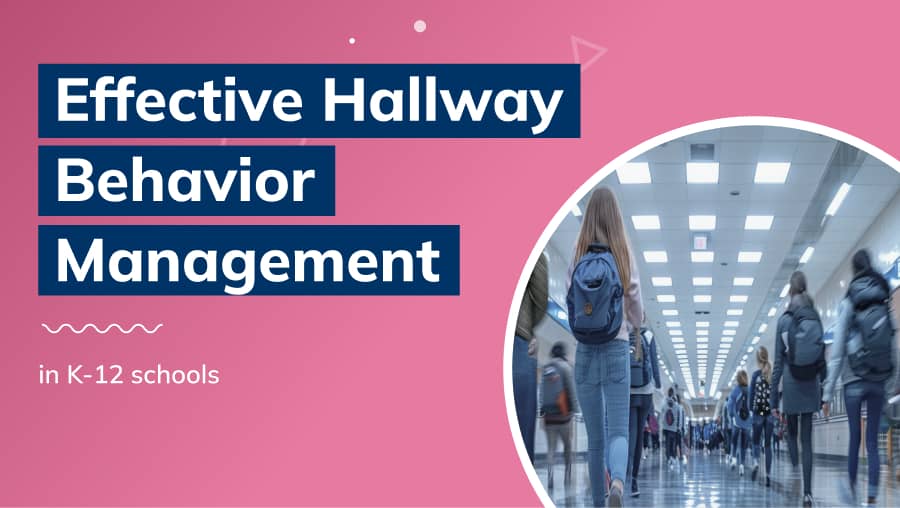
Hallway behavior affects how safe a school feels, how much learning time gets protected, and how students treat each other in shared spaces. When hallways run smoothly, the whole building feels calmer.
When hallway behavior breaks down, however, it shows up everywhere: more late arrivals, more stress, more conflicts, and more interruptions. The good news is that hallway behavior can improve quickly when a school sets clear expectations and uses simple, consistent systems to keep its hallways calm and its classrooms focused.
What is Hallway Behavior?
Hallway behavior refers to how students act while moving through the school building during passing periods, before and after school, and during bathroom breaks. It includes things like how loudly students talk, whether they keep moving or crowd around, how they treat other people in shared spaces, and whether they follow basic safety rules like walking and keeping their hands to themselves.
Strong Hallway Behavior Usually Looks Like:
- Walking with purpose
- Keeping voices at an appropriate level
- Respecting personal space
- Following traffic patterns
- Returning to class quickly
- responding respectfully to redirection
Problem Hallway Behavior Usually Looks Like:
- Running, yelling, or horseplay
- Clustering and blocking traffic
- Wandering without a destination
- Filming peers without permission
- Ignoring adult direction
- Meeting up in bathrooms or unsupervised areas
- Vaping or vandalism in low-visibility spaces
Why Hallway Behavior Matters
Positive hallway behavior can help students get to class on time and ready to learn. It creates a school culture where people feel respected. Negative hallway behavior, however (running, yelling, filming, crowding, bullying, loitering) can make school feel chaotic, even if classrooms are well managed.
Clear Expectations: Simple Rules Students Can Actually Follow
Students can’t follow rules they don’t understand (or can’t remember). Hallway expectations work best when they are short, specific, and repeatable. But the biggest hallway issues change as students get older, so expectations should match the grade level.
Elementary school
In elementary schools, the main issues are usually safety, staying with the class, and keeping transitions calm (especially when students are excited or in a hurry).
Elementary hallway expectations often focus on:
- Walking feet (no running)
- Hands to self (no pushing or grabbing)
- Quiet voices (so nearby classes can keep learning)
- Stay in line and follow your teacher
- Use stairs safely (one step at a time, hold the railing)
Middle school
Middle school hallways tend to be louder and more crowded, with more stopping to talk, friend groups blocking traffic, and conflicts that can start quickly.
Middle school expectations often focus on:
- Keep moving during passing time (no hanging out in the hallway)
- Keep to the right so traffic can flow
- Use a normal speaking voice (not shouting across the hall)
- No physical play (no play-fighting, tackling, or roughhousing)
- Respect personal space (no bumping, cutting, or crowding)
High school
In high school, the biggest problems are often cutting class, wandering with passes, filming/posting photos, and conflicts that draw a crowd.
High school expectations often focus on:
- Be where you’re supposed to be (go straight to class)
- Use hall passes the right way (one destination, one purpose, return on time)
- Keep hallways clear (don’t sit or block doorways, stairs, or corners)
- No filming or posting other students without permission
- If there’s a problem, get help-don’t gather a crowd
To make expectations stick at any age, schools can post them where they matter (on an online portal, near stairs, lockers, exits) and use quick reminders before busy transitions.
Why Schools Struggle to Fix Hallway Behavior
If a school has tried to fix hallway behavior and nothing sticks, the issue is usually not student motivation alone. It is often a systems problem.
Common causes include:
- Unclear expectations: Students cannot meet hallway behavior expectations that they were never explicitly taught.
- Inconsistent enforcement: If one adult redirects and another ignores the same behavior, students learn the system is optional.
- No visibility into patterns: If schools cannot see who is out, where students are going, or how long they are gone, hallway behavior management becomes guesswork.
How to Fix Hallway Problems: Actionable Systems That Work
If hallways feel out of control, the goal is to make them predictable. That usually means improving traffic flow, tightening transitions, and reinforcing the behaviors you want to see.
Here are practical fixes many schools use:
- Improve traffic flow: use one-way routes in tight areas, keep stairs up and down when possible, and clearly mark keep-right lanes.
- Reduce crowding: stagger passing periods by grade level or let out classrooms in waves.
- Cut down on hallway wandering: tighten the hall pass process and limit how many students can be out at once.
- Use positive recognition: notice the students who are doing the right thing and reward consistency.
- Give students a role: use student ambassadors (not enforcers) to support a respectful hallway culture.
Bullying, Conflicts, and Safety in the Hallway
Because hallways are public and crowded, conflicts can start fast and spread fast. A strong hallway plan makes it harder for bullying and unsafe behavior to hide.
What helps most is having clear steps students can follow:
- How to report bullying or harassment (and what happens after a report, such as automated detentions and consequences)
- Where to go if you don’t feel safe
- What to do if you see a conflict starting (get help early, don’t gather a crowd)
Systems that make reporting and follow-up easier can help schools respond more quickly and prevent recurring problems.
Check What’s Working and Keep Improving
Hallway behavior improves more when schools treat it like a system, not a lecture. Monitor what’s happening, make one change at a time, and keep what works.
Useful ways to improve over time:
- Ask students where problems actually happen
- Review behavior data by location and time of day
- Adjust traffic patterns, pass rules, or transition timing based on what you find
Hallways Shape the Whole School Day
Hallway behavior can either support learning or constantly interrupt it. When expectations are clear, calmer hallways do more than just reduce noise. They create safer transitions, stronger routines, more instructional time, and a better school day for everyone.