PBIS stands for Positive Behavioral Interventions and Supports. Learn what PBIS means, how the three tiers work, and how schools use points, rewards, and data to build a positive school climate.
If a child doesn’t know how to read, we teach. If a child doesn’t know how to behave, we… teach? …punish?”
— Tom Herner, NASDE President, 1998
That quote is almost 30 years old. But it still stops educators in their tracks. Honestly, most schools are still fumbling the answer to that last question.
PBIS is built on a different approach. And for the thousands of schools that have gotten it right, it really does change things: fewer office referrals, calmer hallways, stronger relationships between teachers and students, and a school culture that works for kids instead of against them.
Here’s everything you need to know about what is PBIS and how it works in schools.
What Is PBIS?
PBIS stands for Positive Behavioral Interventions and Supports. At its core, it’s a school-wide framework that focuses on teaching and reinforcing positive behavior. Not just waiting for something to go wrong and reacting.
The PBIS meaning is actually pretty simple: schools set clear behavioral expectations, teach them explicitly, and recognize students when they follow through. Instead of assuming kids know what “respect” looks like in the hallway vs. the cafeteria vs. the classroom, PBIS schools teach it. Specifically. Repeatedly. And with consistency across every adult in the building.
PBIS was formally introduced through the 1997 reauthorization of the Individuals with Disabilities Education Act (IDEA). It started as a way to support students with disabilities and has since grown into a framework used for all students, in all settings, at every grade level.
Today, more than 27,000 schools across the United States use PBIS. The research backing it up is extensive. Schools that implement it well see fewer discipline referrals, better attendance, stronger academic outcomes, and teachers who are less burned out.
What Does PBIS Stand For in Education?
PBIS stands for Positive Behavioral Interventions and Supports. Understanding the PBIS meaning comes down to what each word actually tells you about how it works.
Positive means the focus is on what students should do, not just what to avoid. You’re teaching the behavior you want to see, not just punishing the behavior you don’t.
Behavioral grounds the whole thing in behavioral science. Behavior is learned. Which means it can be taught, shaped, and reinforced, just like reading or math.
Interventions means there are specific, evidence-based strategies at different levels of intensity. It’s not one-size-fits-all.
Supports is maybe the most important word. The goal is helping students succeed, not just managing them. Skill-building over compliance.
Put it all together and PBIS in schools is really about creating an environment where positive behavior becomes the norm, not the exception.
What Is PBIS Made Of? The Five Core Elements
PBIS isn’t a packaged curriculum you buy and roll out on day one. It’s a framework, which means every school looks a little different. But according to PBIS.org, all effective PBIS programs share five core elements.
1. Clear Outcomes
Schools need to define what success actually looks like. That means real, measurable goals: reduce office discipline referrals by 20%, improve attendance, increase the percentage of students meeting grade-level expectations. Without clear outcomes, it’s hard to know if anything you’re doing is working.
2. Data-Driven Decision Making
PBIS doesn’t run on gut feelings. Schools collect and review behavior data regularly to understand what’s working, what’s not, and where students need more support. (More on this in a bit.)
3. Evidence-Based Practices
Every intervention in PBIS has a research base behind it. Schools choose strategies that have been shown to work, not just strategies that feel familiar or comfortable.
4. Systems Support
One of the most common PBIS pitfalls is inconsistency. The framework needs clear processes, shared language, and regular team check-ins so that every staff member is implementing it the same way, not just the teachers who are enthusiastic about it.
5. Equity at the Core
Good PBIS programs account for the fact that students come from different backgrounds and life experiences. Expectations are taught in context. Consequences are applied fairly. And research shows that centering equity within PBIS can significantly decrease racial disparities in discipline practices. And that matters a lot.
What Is PBIS? Understanding the Three Tiers
PBIS uses a three-tier model where each tier represents a different level of support. Students don’t move through tiers like levels in a game. They get support at whatever level they need, and that can shift throughout the year.
Image needed: PBIS three-tier pyramid diagram. Tier 1 at the base (all students), Tier 2 in the middle (some students), Tier 3 at the top (few students). To be generated or sourced.
PBIS Tier 1: Universal Support (All Students)
Tier 1 is the foundation. It covers every student, every staff member, and every corner of the school: classrooms, hallways, cafeteria, bathrooms, the parking lot.
At Tier 1, schools:
- Define three to five school-wide behavior expectations (things like: Be Respectful, Be Responsible, Be Safe)
- Teach those expectations explicitly, in every setting, all year long
- Recognize students when they demonstrate positive behavior
- Use consistent, predictable responses when expectations aren’t met
Research suggests about 80% of students respond well to Tier 1 alone. A strong Tier 1 is the single biggest lever in PBIS. Schools that skip it and jump straight to individual interventions almost always struggle. The foundation isn’t there.
Tier 1 isn’t complicated. It’s consistent. And that consistency, every adult, every day using the same language, is where the real power comes from.
PBIS Tier 2: Targeted Support (Some Students)
About 15% of students need a little more than school-wide expectations to stay on track. Tier 2 provides additional, targeted support for those students, without requiring the intensive planning that Tier 3 involves.
Common Tier 2 PBIS interventions include:
Check-In/Check-Out (CICO): Students start and end each day with a quick check-in with a trusted adult. They get feedback on their behavior throughout the day and set goals for the next. CICO is one of the most well-researched Tier 2 interventions out there and consistently shows strong results.
Social Skills Groups: Small-group instruction focused on specific skills: managing frustration, reading social cues, resolving conflict. Targeted, time-limited, tied to what the student actually needs.
Behavior Contracts: A written agreement between the student, teacher, and family that spells out specific goals and the supports the school will provide.
Increased Positive Attention: Sometimes the most effective Tier 2 support is simply making sure certain students are getting more positive interactions with staff. Not more corrections. More connection.
Tier 2 supports are designed to be efficient enough that any teacher can implement them without needing a specialist involved. The whole point is catching students before they need something more intensive.
PBIS Tier 3: Intensive Support (Few Students)
Fewer than 5% of students need Tier 3 support. These are students with persistent, complex behavioral needs that haven’t responded to Tier 1 or Tier 2.
At this level, support is fully individualized and typically involves:
- A Functional Behavior Assessment (FBA) to understand the root cause of the behavior
- An individualized Behavior Intervention Plan (BIP) built from the FBA findings
- A team approach: classroom teachers, school psychologists, counselors, special ed staff, and families all working together
- Frequent progress monitoring to see if the plan is actually working
Tier 3 requires significant time and specialist expertise. The good news: schools with strong Tier 1 and Tier 2 systems tend to have fewer students who get here, which frees up the capacity to really support the ones who do.
So What Is PBIS Actually Doing? What the Research Says
If you’re asking what is PBIS and whether it actually delivers results, the evidence is pretty compelling.
Fewer referrals and suspensions. A nine-year study by Madigan et al. (2016) found that schools implementing PBIS with moderate to high fidelity saw a 36% reduction in office discipline referrals and a 24% decrease in suspensions compared to control schools. One study of a rural middle school found a 42% drop in referrals.
Less bullying. Randomized controlled trials have found significant effects on bullying and peer rejection, with a separate RCT across 37 schools showing reduced aggressive behavior and peer rejection.
Better academics. Students in PBIS schools show statistically significant improvements in reading and math scores, particularly for students with the most significant behavioral needs. And students in PBIS schools are 33% less likely to receive a discipline referral than those in comparison schools, which means more time in class, learning.
Happier teachers. According to the Center on PBIS, teachers in PBIS schools report feeling less emotionally exhausted, more connected to their students, and more capable in their work. That’s a big deal when teacher burnout is at an all-time high.
Better outcomes for students with disabilities. A 2025 systematic review found a positive association between implementing PBIS at Tier 1 with fidelity and reduced rates of exclusionary discipline for students with disabilities.
The bottom line: when PBIS is implemented well, school communities thrive. That’s not marketing. It’s what the data consistently shows.
The Importance of Data in PBIS
Here’s the thing about PBIS: the framework is only as good as the data you’re willing to look at. Schools that implement PBIS without consistent data collection often find themselves running programs that feel busy but aren’t actually moving the needle.
The most widely used data framework in PBIS is called the Big 5:
- What behaviors are happening most often?
- Where are they happening?
- When during the day do they spike?
- Who are the students involved?
- How often are incidents occurring?
Working through these five questions regularly helps schools shift from reaction mode to prevention mode. If your data shows that 60% of behavior incidents happen in the hallway between second and third period, that’s probably a systems problem, not a student problem. You can redesign the transition, add supervision, or teach specific expectations for that setting.
Good data also helps catch bias before it becomes entrenched. Schools that regularly review discipline data by race, grade level, and gender are far more likely to notice if certain groups of students are being referred at disproportionate rates. Equity-focused data review is a best practice in every strong PBIS program. And honestly, it’s just good practice for any school.
What to track:
- Office Discipline Referrals (ODRs)
- Attendance data
- Points and recognition data
- Tier 2 and Tier 3 progress monitoring
- Staff perception surveys
How often: Most PBIS teams review school-wide data monthly and individual student data weekly. These meetings don’t need to be long. Thirty minutes with the right people and the right data is genuinely enough.
PBIS Points and Rewards
One of the most visible parts of a PBIS program is the recognition system. Students earn points when they demonstrate the school’s behavior expectations, then redeem those points for rewards through a PBIS store.
Some people hear this and immediately think: bribery. It’s worth addressing that directly, because there’s a real difference.
Bribery is offering something before the behavior to get compliance. Reinforcement is recognizing behavior after it happens to make it more likely to happen again. PBIS recognition is the latter. It works because it makes positive behavior visible, valued, and worth repeating. Over time, the external recognition becomes internal motivation.
What Are PBIS Points?
PBIS points are the currency of the recognition system. Teachers and staff award points when they catch students meeting the school’s expectations. Points can be given digitally or with physical tickets, depending on how your school has it set up.
Consistency is everything here. If one teacher is handing out points freely and another is barely using the system, students notice, and the whole thing starts to feel arbitrary. Arbitrary systems don’t change behavior. Predictable, consistent ones do.
PBIS Rewards and the School Store
A PBIS store (sometimes called a school store or reward store) is where students cash in their points. It can include:
- Small tangible items (pencils, stickers, school supplies)
- Privileges (extra free time, choosing your seat, wearing a hat in class)
- Experiences (lunch with a teacher, extra recess, front-of-line pass)
- Bigger items saved up over time (school spirit gear, gift cards, event tickets)
The best PBIS stores have a mix of low-cost items students can redeem frequently and higher-value items that take sustained effort to earn. That range matters. It keeps students at every level engaged, not just the ones who can delay gratification.
PBIS Store Ideas by Grade Level
Elementary: Stickers, bookmarks, fun erasers, pencils, small toys, extra recess, choose your seat, read to the class, lunch with the principal, dress-up day pass.
Middle School: School supplies, snacks, homework passes, free-choice activity time, extra computer time, sit with friends at lunch, early dismissal to class.
High School: Gift cards, school spirit merchandise, parking spot upgrades, senior privileges, event tickets, college prep resources, recognition at assemblies.
One thing worth saying about high school: it’s often the most under-resourced tier of PBIS. Older students absolutely respond to recognition. It just needs to feel appropriate for where they are developmentally. Public praise in front of peers can backfire. Private acknowledgment, tangible rewards, and real privileges tend to land a lot better.
What Makes a PBIS Reward Actually Work?
Specific beats generic every time. “Good job” doesn’t do much. “I noticed you helped clean up without being asked. That’s exactly what responsibility looks like here” actually lands. The more clearly the recognition connects to a specific expectation, the more meaningful it is.
Predictability also matters. Students should know exactly how many points they need for each reward, and the store should be stocked and accessible on a regular schedule, not just when someone remembers to update it.
Related reading:
PBIS Rewards: Building a School Where Students Want to Be
Rewards for Students: PBIS Incentives & Free Reward Examples
PBIS Interventions
PBIS interventions exist at every tier. The right one depends on the student’s needs and what the data is telling you about the behavior.
PBIS Tier 1 Interventions
Tier 1 interventions are universal and preventative. They apply to every student, every day. The most effective ones include:
- Posting and teaching expectations in every setting (not just the classroom)
- Using precorrection (reminding students of expectations before a challenging situation, not after)
- Giving specific, behavior-contingent praise at a high rate
- Active supervision in common areas
- Consistent, predictable responses to minor misbehavior
A useful benchmark: staff should be giving at least four positive acknowledgments for every correction. Schools that track this ratio tend to outperform those that don’t.
PBIS Tier 2 Interventions
Tier 2 interventions are targeted and designed to be efficient. The most common ones (Check-In/Check-Out, social skills groups, behavior contracts, and increased adult check-ins) are covered in the tiers section above.
One key thing to keep in mind: the intervention needs to match the function of the behavior. A student acting out to get attention needs a completely different approach than a student acting out to escape a hard task. Matching the intervention to the function is what makes Tier 2 work.
PBIS Tier 3 Interventions
Tier 3 starts with a Functional Behavior Assessment and builds from there. This is intensive, individualized work, and it’s a team effort. No single educator should be carrying this alone.
Schools with strong Tier 3 systems have clear referral processes, dedicated specialist time, and regular progress review meetings so nothing slips through the cracks.
Related reading:
Behavior Interventions in K-12 Schools
PBIS vs MTSS vs RTI
These three terms get used together constantly, and the differences aren’t always clear. Here’s the short version.
MTSS (Multi-Tiered System of Supports) is the umbrella. It covers academics, behavior, and social-emotional needs using a tiered model of support.
PBIS lives inside MTSS. It’s the behavioral piece: the systems, practices, and data structures that support student behavior within the larger MTSS framework.
RTI (Response to Intervention) was originally built to identify students who might need special education. It now refers more broadly to tiered academic intervention. Like PBIS, it sits within MTSS. A lot of educators use RTI and MTSS interchangeably, though MTSS is the more complete term.
Put simply: MTSS is the whole system. PBIS is the behavior piece. RTI is the academic piece.
Related reading:
What is MTSS? A Complete Guide on Multi-Tiered Systems of Support
Understanding MTSS Interventions for Student Success
Using an RTI Scheduler for Intervention & Enrichment Periods
What Is PBIS Like in High Schools?
PBIS grew up in elementary schools. That’s where most of the early research was done, and it shows. The evidence base at the elementary level is really strong. But high school PBIS has grown a lot, and for good reason.
Research examining PBIS across high schools in 37 states found positive relationships between PBIS implementation and both behavior and attendance outcomes in schools that implement with fidelity. Longitudinal studies in middle and high schools also show that the longer a school has had PBIS in place, the better the outcomes: fewer referrals, better climate, more positive student perceptions of school.
But here’s the reality: what is PBIS at the elementary level and what is PBIS at the high school level are two different things in practice. You can’t just take an elementary PBIS model and drop it into a high school. The framework has to grow up with the students.
Relevance matters more. High schoolers are more likely to buy into PBIS when the expectations connect to real life. Schools that frame expectations around college and career readiness (showing up on time, meeting deadlines, communicating professionally) tend to see stronger engagement than schools that keep it generic.
Relationships are the whole game. At the high school level, the quality of the teacher-student relationship is the single biggest predictor of whether a student will respond to an intervention. Advisory programs, mentoring, and regular check-ins aren’t optional extras. They’re infrastructure.
The data picture is more complex. In high school, behavior incidents are often downstream of chronic absenteeism and course failure. PBIS programs that only track ODRs miss a lot. Integrating attendance and academic data into your decision-making gives you a much fuller picture.
The rewards need to be real. Stickers don’t motivate a 16-year-old. Gift cards, senior privileges, event access, parking upgrades. These do. High school PBIS stores that reflect the actual interests and maturity of their students see much higher participation in the recognition system.
Related reading:
PBIS in High Schools
Getting Started With PBIS in K-12 Schools
Once you understand what PBIS is and why it works, the next question is: how do you actually build it? PBIS is a long-term commitment, not a quick fix. Schools that try to implement everything at once tend to get overwhelmed and abandon the framework before it has time to actually work.
Here’s what the most successful implementations tend to have in common.
1. Build Your Team First
You need a dedicated PBIS team: people who own implementation, review data, make decisions, and keep momentum going when things get hard. Good teams include representation from admin, classroom teachers, and support staff, and ideally include student and family voices too.
Plan for regular meetings. Monthly is typical for school-wide data. Protect that time.
2. Get Tier 1 Right Before Anything Else
Seriously. Don’t rush to Tier 2. Define your three to five school-wide expectations first. Teach them explicitly. Build your recognition system. Get the whole staff trained and aligned.
A strong Tier 1 takes a full school year to really embed. That’s not slow. That’s realistic.
3. Make the Recognition System Easy to Use
If your point system takes more than a few seconds to use, teachers will stop using it. That’s just the reality. Complicated systems collapse in the first month. Simple, consistent systems are what actually change behavior over time.
Digital platforms make a real difference here. When a teacher can award points in three seconds from their phone, they do it. When it means finding a paper ticket, writing it out, and dropping it somewhere for later entry, it doesn’t happen.
4. Never Stop Reviewing Data
The schools that sustain PBIS for years are the ones that never stop looking at their data. Schedule your data review meetings before the school year starts, put them on the calendar, and protect them like you would any other critical meeting.
5. Plan for the Long Haul
PBIS works when it becomes part of the school’s culture, woven into onboarding, professional development, and how the building runs. When it’s a program that operates alongside the culture instead of inside it, it fades. Build leadership capacity so the work doesn’t fall apart if your PBIS champion moves schools.
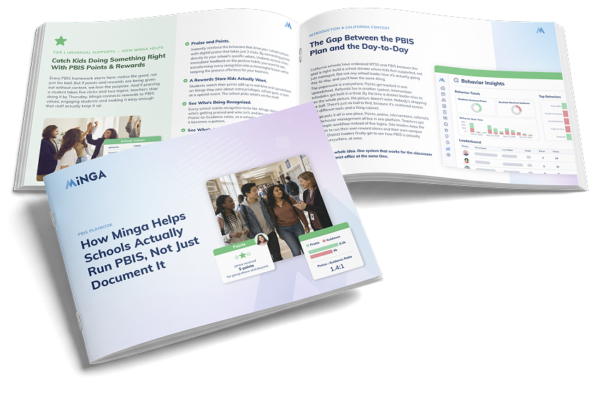
How Minga Supports PBIS in Schools
Minga is a school culture platform built to make PBIS easier to run, for everyone.
PBIS Points and Recognition: Teachers award points directly from the Minga app in seconds. No paper tickets, no data entry at the end of the day. Points flow automatically into each student’s account.
PBIS Store: Minga’s built-in school store lets administrators build a custom reward catalog. Students can browse and redeem their points on their own. Admins control inventory, pricing, and availability from one dashboard.
Behavior Tracking: Minga makes it easy to log behavior incidents consistently and spot patterns across classrooms and grade levels, so you can identify students who might need more support before things escalate.
Real-Time Data: Admins and counselors can see recognition and behavior data in real time. No end-of-month scramble to pull reports. The data is always current.
PBIS works best when the system is easy enough that people actually use it. That’s what Minga is built for. When the tools get out of the way, educators can focus on what actually moves the needle: relationships, recognition, and consistent expectations. See how Minga supports your PBIS program. Book a demo.
Frequently Asked Questions: What Is PBIS and How Does It Work?
- What does PBIS stand for? PBIS stands for Positive Behavioral Interventions and Supports.
- What is the PBIS meaning in schools? PBIS is a school-wide framework for teaching and reinforcing positive behavior. It uses a three-tier model: universal, targeted, and intensive. This meets the needs of all students.
- What are the three tiers of PBIS? Tier 1 is universal support for all students. Tier 2 is targeted support for students who need more than school-wide expectations. Tier 3 is intensive, individualized support for students with complex behavioral needs.
- Does PBIS work? Yes. When schools implement it with fidelity, PBIS consistently leads to fewer office discipline referrals, better attendance, stronger academic outcomes, and less teacher burnout. The research base is strong and spans more than two decades.
- Does PBIS work in high schools? Yes, when it’s adapted for adolescents. Research across 37 states shows positive relationships between PBIS and both behavior and attendance outcomes at the high school level for schools implementing with fidelity.
- What’s the difference between PBIS and MTSS? MTSS is the overarching framework for tiered academic, behavioral, and social-emotional support. PBIS is the behavioral component within it.
- What are PBIS rewards? PBIS rewards are what students earn for demonstrating positive behavior: tangible items, privileges, or experiences that they redeem through a school PBIS store.
- How many schools use PBIS? More than 27,000 schools in the United States currently implement PBIS, with all 50 states and Washington D.C. having a state PBIS coordinator.
Key Takeaways
PBIS isn’t a program. It’s a framework, and that distinction really matters. Programs end. Frameworks become culture.
The schools that see lasting results are the ones that invest in the foundation: clear expectations, consistent recognition, honest data review, and strong relationships between adults and students. It’s not glamorous work. But when it clicks, it genuinely changes the feel of a building.
That’s the real PBIS meaning in practice: a school where every student knows what’s expected, feels seen when they meet those expectations, and gets the right support when they need it.
Ready to Strengthen Student Engagement Across Your School?
Book a demo today and start building a more connected school community.