Ask any of your students why they follow school rules; we can guarantee no one’s answer will be because they’re in the handbook or on a poster in the hall. Kids follow rules based on what actually happens when they break one.
A school discipline policy, whether it’s for tardies, dress code, or classroom disruptions, is only as strong as its follow-through. Giving out a consequence is the easy part. Writing the referral, logging the incident, sending an automated email to Mom and Dad – done.
But the moment that discipline requires manual tracking after the fact, accountability starts to wobble. Details get lost, busy staff miss a step, your students quickly learn just how much they can get away with, and your school rules start becoming suggestions.
When follow-through relies on human memory, sticky notes, and separate rosters, consistency across a school is practically impossible. That isn’t a failure on the part of teachers or admins; it’s a logistics problem.
It’s a challenge school leaders face with almost every type of discipline, but it hits hardest right in the middle of detention management.
Why Consequences Break Down Between Assignment and Follow-Through
A consequence isn’t really a single event. It’s a chain:

Most schools have that first link, the assignment, handled well. Behavior gets logged, a consequence gets attached to it, a parent gets notified. As far as the discipline system is concerned, the box is checked.
Except the actual work hasn’t started yet. Getting that detention served means someone on staff is working through a string of manual steps: finding which session actually has room, writing the student’s name down somewhere, taking attendance and getting that record back to the right person, and noticing if the student skips so someone can follow up.
None of these steps are hard on their own. But multiply them by dozens of students a week, spread across multiple staff members, and the friction adds up fast. A student doesn’t get on the schedule. A room fills without anyone noticing. A no-show slips through because whoever’s running detention on Thursday never got Tuesday’s updated list.
Two students can get handed the exact same consequence for the exact same behavior and end up in two different places: one serves their time, the other learns that consequences are negotiable. That’s not a discipline problem. It’s a logistics problem wearing a discipline costume.
What Consistent Discipline Actually Requires at Scale
Consistency is the thing every school says it wants from its discipline program, and it’s also the first thing that suffers when follow-through depends on manual tracking. If one admin is meticulous about updating the detention roster and another isn’t, two students with the same infraction can end up with two very different experiences: one serves the consequence as intended, the other quietly never does.
That inconsistency isn’t usually a fairness failure in the moment a consequence is assigned. It’s a follow-through failure that happens later, in a step nobody’s watching closely. Fixing it doesn’t mean writing stricter policy. It means removing as many manual steps as possible, so the outcome doesn’t depend on who’s managing the process that week.
Restoring Accountability: Meet Scheduled Detentions
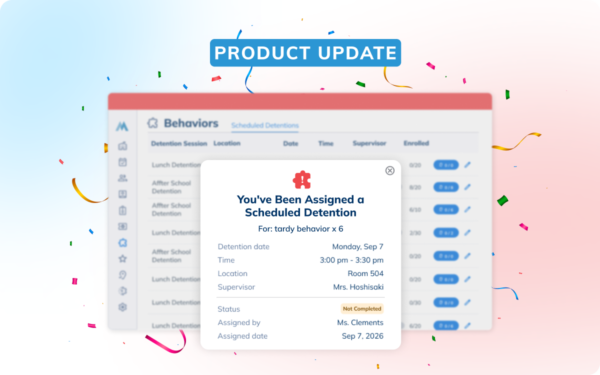
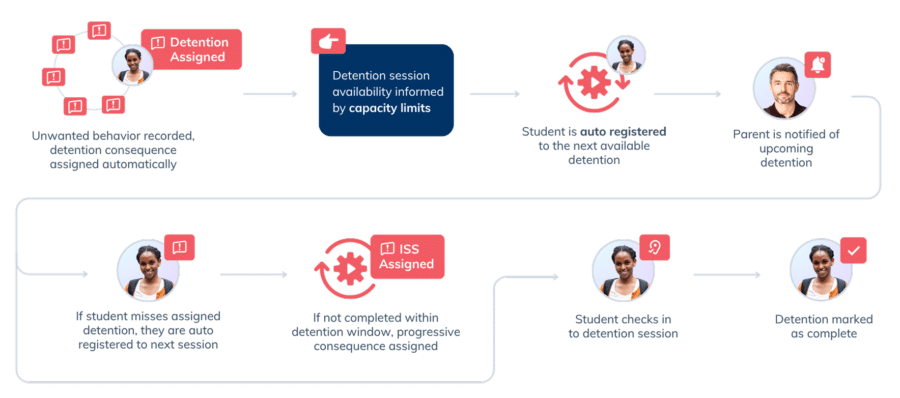
This is where Minga’s Student Behavior Management solution now closes the loop. With scheduled detentions, admins set up detention sessions ahead of time, defined by day, time, location, capacity, and any blackout periods the school needs to account for. The moment a scheduled detention is assigned as a consequence, Minga automatically enrolls the student in the next available session that respects those limits.
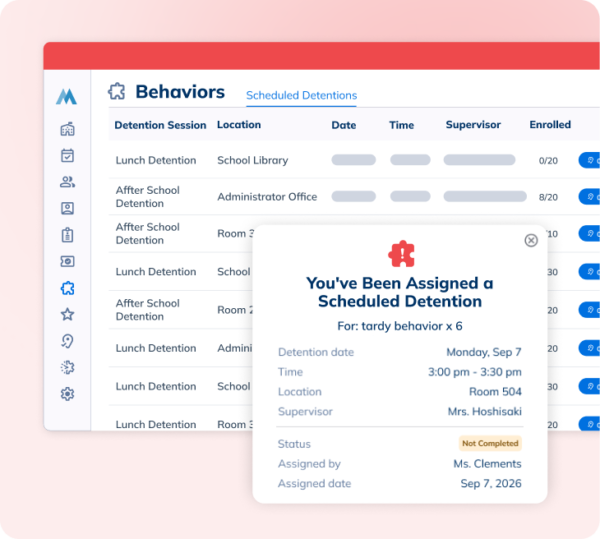
Attendance is tracked right in Minga, so there’s no separate step for confirming who showed up. And because the whole sequence lives inside the same platform where the consequence was assigned, there’s no handoff to a spreadsheet or a whiteboard where details can get lost.
This isn’t a scheduling tool bolted onto discipline. It only works because it’s part of the same consequence and automation framework the rest of Behavior Management in Minga runs on. Assign the consequence, and the scheduling happens as a direct result, not as a separate task for someone to remember later.
Multi-Detentions: Running Complex Progressive Discipline Frameworks Without the Manual Work
Not every situation calls for a single detention. For more serious or repeated behavior, schools often need something with more structure: a progressive, multi-day detention sequence with clear consequences if a student doesn’t follow through along the way.
Minga’s multi-detention feature makes that progressive discipline framework possible without turning it into a manual tracking exercise. An admin can assign multiple scheduled detentions as part of one consequence, each with its own due date and its own escalation trigger. If a student misses a session’s deadline, the next step in the sequence fires automatically.
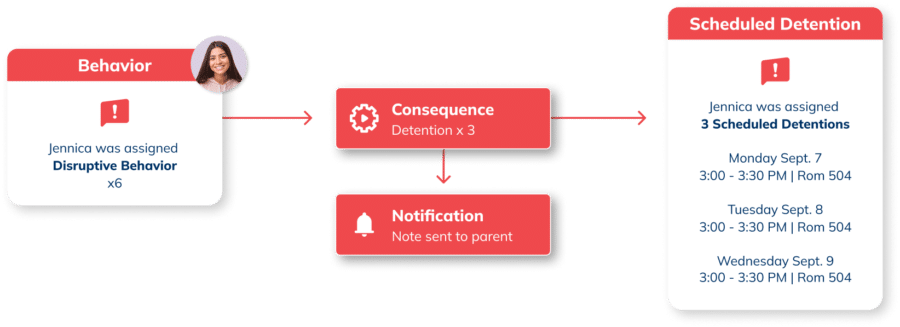
In practice, this gives schools a way to run more complex, progressive discipline entirely inside Minga, similar in structure to an in-school suspension, without anyone having to manually check whether the last step happened before triggering the next one.
Schools already rely on Minga to automate consequences at scale. Golden Valley High logged 7,400+ behavior consequences through the platform in a single year. Scheduled detentions and multi-detentions extend that same automation into the part of the process that’s historically been hardest to keep consistent: making sure the consequence is actually served.
From Consequence to Completion, Entirely in Minga
With new scheduled detentions and multi-detentions, Minga’s Behavior Management solution closes the gap that’s always existed between assigning a consequence and knowing it was actually served. The consequence gets logged, the session gets scheduled, attendance gets tracked, and records update themselves when it’s complete. All without a spreadsheet, a whiteboard, or someone trying to keep it all together from memory.
That’s the real promise here. Not stricter discipline, and not more consequences. Just a program where follow-through doesn’t depend on someone remembering to do it.
FAQ SECTION
- What is a scheduled detention? A scheduled detention is a Minga consequence type that automatically enrolls a student into an available detention session the moment it’s assigned, based on the session’s capacity and any blackout periods the school has set.
- How is a scheduled detention different from a regular detention? A regular, or open, detention is a consequence without built-in scheduling. The when and where are still managed outside Minga. A scheduled detention handles that automatically, enrolling the student directly into a session.
- Can Minga manage in-school suspension? Multi-Detentions gives schools a way to run a more complex, progressive discipline framework, one that resembles the structure of an in-school suspension, with automatic escalation. It’s built to run that framework consistently, not to make a policy decision for the school.
- What happens if a detention session is full? Scheduled Detentions respects the capacity limits an admin sets for each session. If a session is full, the student is automatically enrolled in the next available session with room.
- What happens if a period is canceled after a student is already scheduled? Minga automatically re-enrolls the student in the next available session that has capacity, so no one has to catch the conflict manually.