An admin pulls up the hallway pass log, then the tardy report, then the behavior log, three different views, dozens of rows each – and still ends up asking the same question: “So what actually needs my attention this week?”
That’s not a data problem. Schools have never had more information about student behavior, movement, and patterns than they do right now. It’s a signal problem. Somewhere in all that data is the story of who needs support, which students are on track, and if a small pattern is about to become a bigger one. But finding that story has always meant someone needs to hunt for it themselves in a sea of data.
Reports Tell You What Happened, Insights Answer the Important Questions
Reports have always told admins what happened: how many passes were issued, how many students were tardy, how many behaviors were logged. That’s real, valuable information, and reports are still worth relying on for exactly that. What they haven’t done is tell admins what it means, or where to look next. Turning a spreadsheet full of activity into an actual decision has always required someone with the time to dig for the pattern themselves, and that’s exactly the kind of task that gets pushed to “later” when the school day gets busy.
Minga Insights are built to close that gap. Instead of a report that says what happened, each one surfaces the answers to the specific questions admins are already asking. Acting on the data no longer depends on someone finding the time to dig for the story themselves.
No Party Group Insights: Spotting Meetups Before They Happen
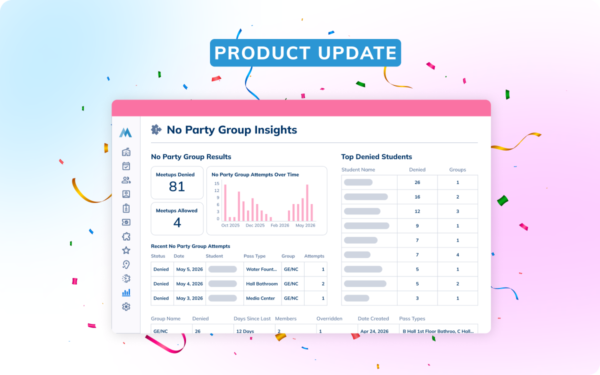
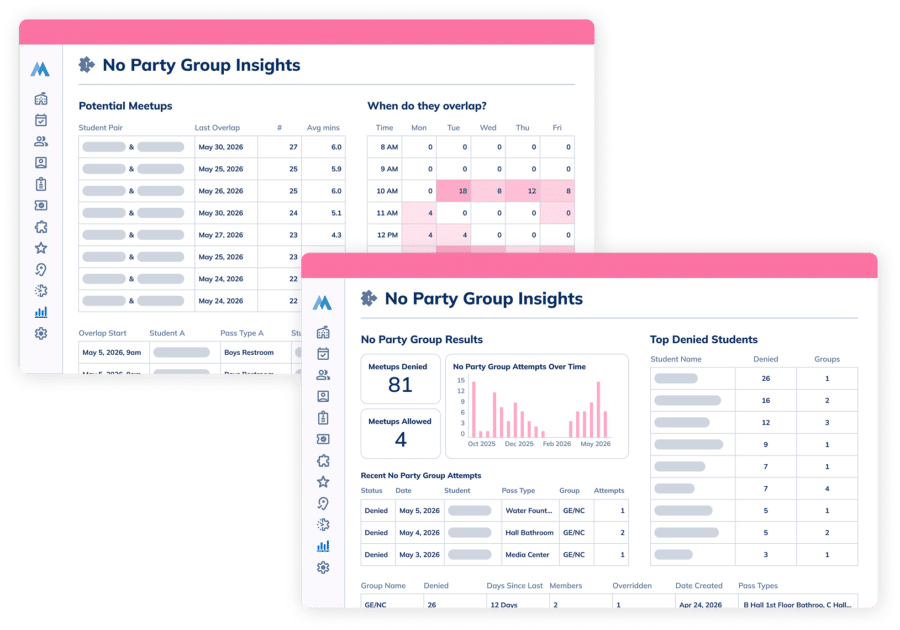
No Party Groups have always been a reliable way to keep certain students apart in the hallway in Minga, but they’ve only ever worked if an admin already knew which students needed separating. If a new pattern was forming, there was no way to see it until something happened. And once a group existed, there was no easy way to know whether it was actually working.
No Party Group Insights change both sides of that. It analyzes a school’s hallway data to show who’s potentially meeting up and when, which students should be in a No Party Group but aren’t yet, and how many potential incidents are being prevented. For groups that already exist, it shows whether they’re working, how often overrides are being granted and by whom, and flags groups that haven’t been triggered in a while and could be re-evaluated.
That last part matters as much as the first. A No Party Group isn’t something to set up once and forget. Minga Insights treats it as something to keep checking on, the same way an admin would want to.
Tardy Insights: Trends and Early Warning Signs
Every school knows tardiness is a problem, but the full shape of it has always been hard to see. And tardiness rarely stays just tardiness; it’s often the first sign a student is starting to disengage, with chronic absenteeism close behind.
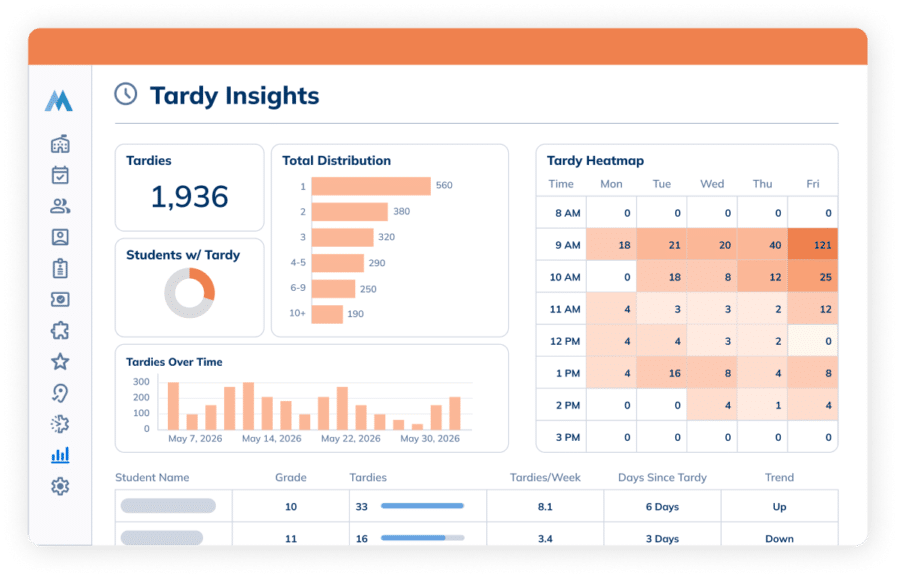
Tardy Insights gives admins two different views for two different conversations. At the campus level, it shows how big the tardy problem actually is, whether it’s trending up or trending down, and when tardiness is causing the most disruption. At the student level, it surfaces who’s struggling and needs attention, and who’s becoming more punctual and deserves recognition for it.
That campus-to-student connection is also an attendance story. Tardiness is the early signal that shows up before absenteeism does, and absenteeism directly affects Average Daily Attendance and school funding. Seeing the trend early means admins can act before a student starts missing days, not after.
Behavior Insights: Equity and the Praise-to-Guidance Ratio
Praise and guidance get logged hundreds of times a week across a school, and even when all that data exists, making sense of it is hard. Without a clear view of the full picture, the same students keep getting recognized while others go unseen, and early warning signs get missed until they’ve already escalated.
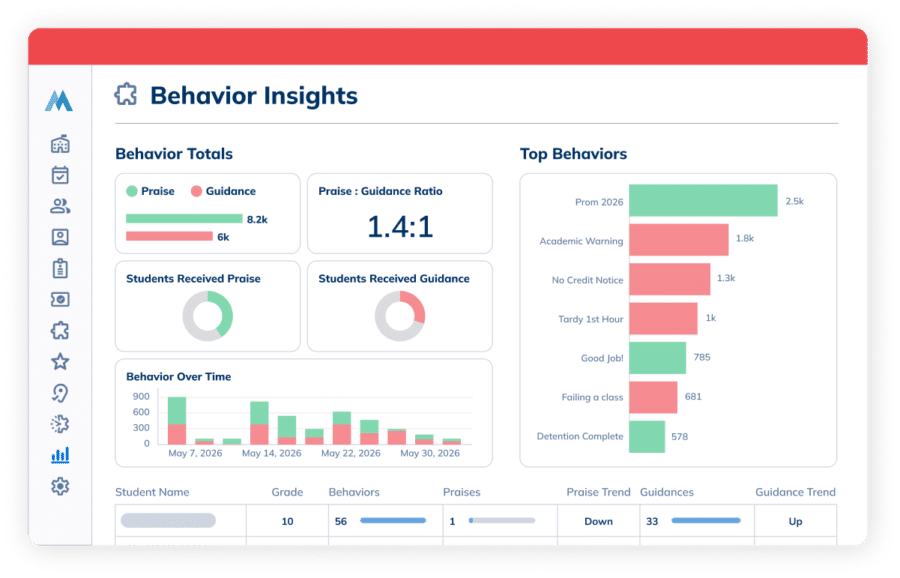
Behavior Insights surfaces both sides of that picture together, not as two separate conversations. At the campus level, it shows how balanced praise and guidance are, which behaviors are most common, and how evenly praise is distributed across the school. At the student level, it highlights who’s excelling, who’s trending in the wrong direction, and who’s in need of support, as well as which staff are assigning behaviors.
The praise-to-guidance ratio on its own is a number worth paying attention to; it’s the kind of stat that resonates in a staff meeting or a board report. But the equity angle is just as important: which students are being recognized, and which aren’t, is a question every school should be asking, and now there’s a direct, data-informed way to answer it.
From Reports to Action
Schools already see real results when they act on what Minga surfaces. Schools using Minga’s Tardy Management solution reduce tardies from 100 tardies per day down to 6 per day, in just 4 months (Montgomery High), and one school cut tardies from over 150 students in the hall after the bell down to five (Irons Middle School). Schools using Positive Behavior & Rewards have seen a 93% increase in positive behavior (Allen High). Minga Insights are what make results like that easier to get to and easier to sustain, by showing admins exactly where to focus before a small pattern becomes a bigger one.
That’s the real shift here. Minga has always run the school day: passes, tardies, behavior, all logged and tracked. Now it helps admins understand that day too: what’s trending up, what’s trending down, and which student could use a hand before a pattern becomes a problem.
When the story in the data is this clear, admins spend less time digging for answers and more time doing the part of the job that matters most: showing up for the students who need them.
FAQ SECTION
- What are Minga Insights? Minga Insights are a set of reports, including No Party Group Insights, Tardy Insights, and Behavior Insights, that analyze a school’s existing Minga data and surface direct answers to the questions admins are already asking, rather than requiring admins to build their own analysis from raw reports.
- Is this an AI feature? No. Minga Insights are data-informed reports built from a school’s own hallway, tardy, and behavior data, not an AI-generated analysis.
- Do teachers see insight reports? Insight reports are available to owners and managers by default, and can be shared with specific teachers and staff at admin discretion.
- How does No Party Group Insights help prevent hallway incidents? It analyzes hallway data to flag students who are potentially meeting up before an incident happens, shows which existing No Party Groups are effective, and highlights groups that haven’t been triggered recently and may need re-evaluating.
- How is Tardy Insights different from a regular tardy report? A regular report shows what happened. Tardy Insights adds trend direction at the campus level and flags which individual students need attention or deserve recognition, connecting tardiness to the earlier warning signs of absenteeism.