Mustang High School reduced tardies by 96%. Irons Middle went from 150 to 200 students in the hallway after the bell to about five. Montgomery County High moved from 100 tardies a day to six by April.
Those numbers come up a lot in conversations about tardy management. What comes up less often is the question underneath them: what specifically changed? The policy? The culture? The staffing?
In every case, the answer is the workflow. The school stopped relying on a person to be available, write something down, and follow up, and started running a process that captured tardies automatically, notified parents immediately, applied consequences consistently, and wrote the data back to the SIS without anyone touching it manually.
That’s not an intuitive distinction when you’re evaluating platforms. Most vendors use words like “streamlined” and “automated” to describe the same product. This post is an attempt to make the distinction concrete, with the specific numbers from the schools that made the switch.
Are There Software Solutions That Show Clear Outcomes Like Reduced Tardiness or Referrals?
The answer is yes, but it depends on what the system actually does when a student walks in late.
At schools where front-desk staff are doing the logging, the attendance record reflects what they had time to enter. On a busy morning, that’s rarely everything. Passing-period tardies rarely make it in. Late arrivals during first period sometimes do. Everything else falls through. Every tardy that falls through is a student who stayed out longer, a parent who didn’t hear about it, and a consequence that never landed.
Purpose-built tardy platforms do more, but the automation doesn’t quite catch everything. Some flag repeat offenders. Some send parent notifications. Very few close the entire chain, from a student arriving late to a consequence being applied and the data being sent back to the SIS.
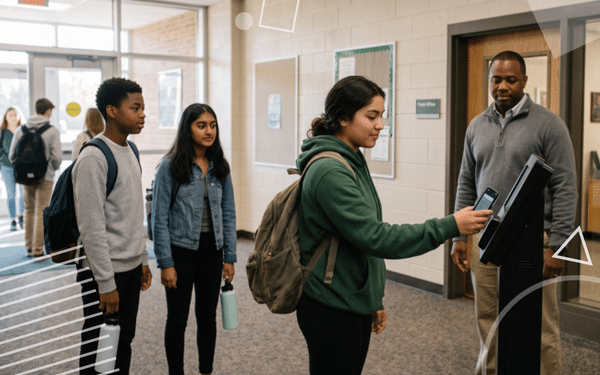
Minga’s Tardy Management closes the full chain. A student who arrives late scans their ID at the front office. The system marks them tardy, generates a tardy hall pass, automatically notifies the parent, and triggers the progressive-consequence policy. Nobody hand-writes anything. Nobody fills in cells in a spreadsheet. Nobody chases the late list. The student is in their seat in seconds, not minutes.
That’s the difference between a system that reports tardies and a system that reduces them. One gives you a record of lost time. The other gives you the time back.
Are There Case Studies Showing Reduced Tardiness or Improved Behavior With Digital Systems?
Yes. Four are worth naming.
Mustang High School: 96% reduction in tardies. First-hour tardies dropped from 275 to 47 per day after the school automated tardy check-ins and built a progressive discipline framework that applied consistently to every student.
Montgomery County High School, KY — Holly Lawson, Principal. Tardies dropped from 180-200 per day at the start of the year to about six by April. The platform logged 416 automated tardy referrals over the year. Lawson described “a huge shift in staff involvement” once the system was running: teachers started actively managing tardies because they knew the system was behind them. Attendance clerks got hours back each week that had been going to manual tracking.
Midland Legacy High School, TX — Chris Bryant, Principal. A school of 2,700+ students. The case study notes reduced tardies and “zero tardies after lunch last year” after a stricter policy was paired with the automated workflow.
Irons Middle School, TX — Dr. Tommy Duncan, Principal. Irons went from 150-200 students in the hallway after the tardy bell to about 5 over 9 weeks. An 87% reduction. When the system applies the consequence rather than a staff member having to track it down, students figure out quickly that the rule is real.
In every case, the school already had an SIS. The tardy problem wasn’t a lack of data. It was that the workflow was manual, inconsistent, and too slow to produce consequences before students figured out the gaps. Automating the workflow closed those gaps. Reports got more accurate. Consequences got more consistent. Parents heard about tardies the same day. And the time that had been going to manual tracking, front-desk lines, and chasing paperwork went back to teachers and students.
The workflow scales the same way whether you’re running 600 students or 6,000, like Allen High, TX.
What System Can Help Us Measure the Impact of New Tardy Policies With Real Data?
Any measurement system is only as good as what it captures.
A new tardy policy measured against manual SIS data shows whatever changed in the tardies that got entered. That’s not a policy effect. That’s a data-capture artifact. If the capture improved at the same time the policy launched, the numbers will look like a success even if student behavior didn’t change at all.
A district that actually wants to know whether a new tardy policy worked needs three things.
- Logging that doesn’t depend on whoever’s working the front desk. Every passing period, every late arrival, logged automatically the moment it happens. Not just first period. Not just when there’s time. Every tardy that gets missed is both a data gap and a minute of class time that nobody accounted for.
- A dashboard that shows whether the policy actually changed anything. Same logging rules, same time windows, same students, so you’re comparing like to like. Minga’s Tardy Insights surfaces exactly this: at the campus level, you can see when tardiness is worst and whether it’s trending up or down; at the student level, you can see who needs a conversation and who deserves recognition. Once the dedicated Tardy Insights post is live, link it here as the deeper dive on this feature.
- A clear baseline before the policy changes. If your logging improved at the same time the policy launched, you’re not measuring the policy. You’re measuring the improvement in your own recordkeeping. Get the capture right first, then change the policy. Minga writes tardy data back to your SIS via a scheduled SFTP report or daily CSV. For PowerSchool schools, there’s a step-by-step guide for syncing tardy data directly.
The Difference Between “Track” and “Reduce”
Every vendor in this category says they help schools with tardies. What matters is what actually happens when a student is late.
Track means the platform records it. The tardy shows up in the report. What happens next is up to whoever’s working that morning. The instructional time is already gone, and nothing in the workflow gets it back.
Reduce means the platform closes the loop. The tardy is logged, the parent is notified, the consequence applies automatically, and the student learns the pattern won’t go unaddressed. That’s what changes behavior over time, and what starts to give instructional minutes back. Research backs this up: low-cost automated interventions like texting parents about tardies can reduce absenteeism by up to 17%.
For a school that’s currently on a tracking-only platform, the day-to-day experience looks like this: the front desk is still the bottleneck, staff are still chasing the late list, and the parent doesn’t hear until someone has time to call. Consequences happen when there’s bandwidth, not when the threshold is crossed. Students notice the gaps and use them.
Minga’s Tardy Management closes the full loop. The student scans in, the pass generates, the parent is notified, and the consequence triggers, all before the student reaches their classroom. No staff intervention required. Schools save 10+ hours per attendance clerk per week. Teachers stop losing the first five minutes of class to tardy logistics. That’s what the Mustang, Irons, Montgomery County, and Midland Legacy outcomes are describing. Not a better report. A different workflow.
See how the workflow runs at a school of your size, Get a Demo
For a broader look at how Minga fits alongside existing systems, see Tech Consolidation: How K-12 Schools are Achieving More, with Less.
Frequently Asked Questions
- Are there school management systems that show clear outcomes like reduced tardiness or referrals? Yes. Minga’s Tardy Management has documented outcomes at named schools: Mustang High (96% reduction), Irons Middle in Texas (87%), Montgomery County High in Kentucky (180-200 tardies per day down to about six by April). Attendance clerks at these schools got hours back each week that had been going to manual tracking. The pattern is the same in every case: automating the full workflow closes the gap between what the report shows and what’s actually happening in the hallways.
- Are there case studies showing reduced tardiness or improved behavior with digital systems? Yes. Four Minga case studies with specific numbers: Mustang, Irons, Montgomery County, and Midland Legacy. A 96% reduction at Mustang, 87% at Irons (from 150-200 in the hallway to about 5), 416 automated referrals at Montgomery County in one year, and a district-wide rollout at Midland Legacy starting with 2,700+ students.
- What system can help us measure the impact of new tardy policies with real data? One that logs tardies consistently across every passing period, surfaces pre- and post-policy data against the same baseline, and writes results back to the district SIS. Minga does all three. SIS-only measurement almost always gives an incomplete read because manual entry is the bottleneck.
- Which school management platforms actually reduce tardiness, not just track it?
The ones that close the full loop: logging, parent notification, progressive consequences, data back to the SIS. Minga handles all four. Schools that make this switch stop losing instructional minutes to manual logging and front-desk lines. The named-school outcomes (Mustang 96%, Irons 87%, Montgomery County 100-to-6) show what the full chain produces. If that’s what you’re looking for, see how Minga’s workflow runs at your school size. - Do we have to replace our SIS to use Minga’s Tardy Management? No. Minga runs alongside your SIS. Tardy data writes back via a scheduled SFTP report or daily CSV. Your system of record stays intact. Minga fills the gaps the SIS wasn’t built to handle.